Asia tech salary index 2026: how Vietnam’s pay curve keeps founders honest
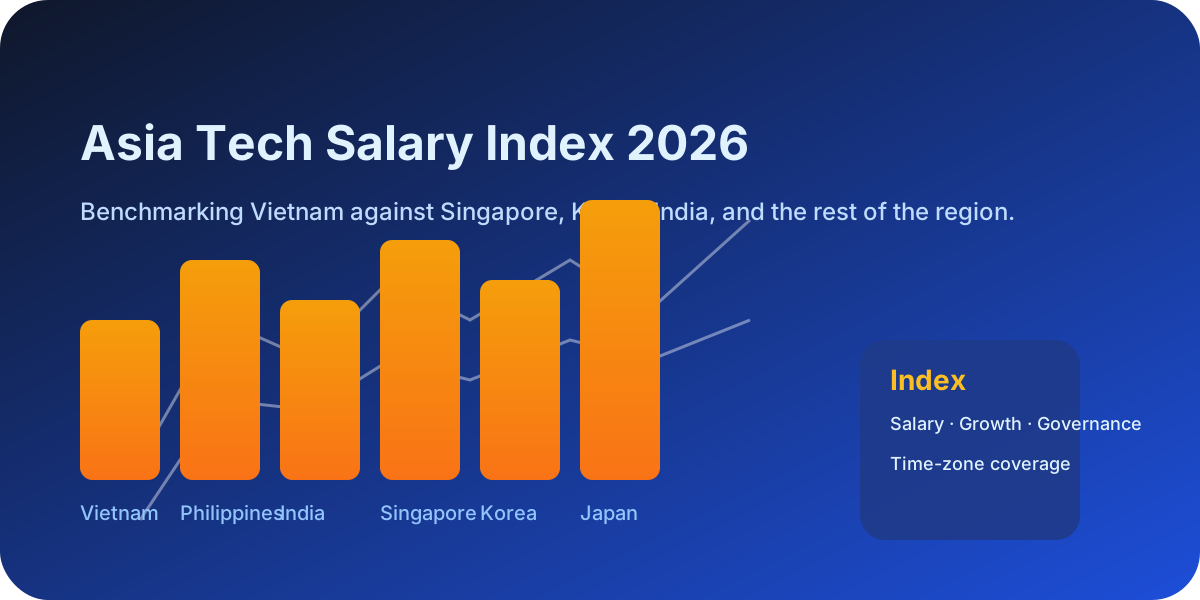
Asia tech salary index 2026 is the compass that keeps sourcing leaders anchored when they compare Singapore, Seoul, India, and Vietnam in the same spreadsheet. If you need to lock the next quarter’s remote or nearshore engineering capacity without guessing which market will pull a governance surprise or send your burn rate sky-high, this index gives you the weighted lens (salary, growth, compliance, time-zone) plus the Vietnam story that most enterprise reports skip.
This guide walks through the index, the underlying signals we pull from regional salary guides and talent platforms, and the path from those numbers to a staffed team—complete with Vietnamese contact points, cost control checklists, and clear next steps.
Asia tech salary index 2026 tiers, growth, and guardrails every sourcing leader needs to weigh
We score each market in Asia across four dimensions: (1) median tech salary, (2) year-over-year growth, (3) governance/resilience (security, vetting, bilingual support), and (4) time-zone overlap for U.S./Europe bedrock markets. The raw salary data borrows from the most recent Hays Asia Salary Guide, and the regional talent momentum is informed by the LinkedIn Economic Graph insights that show where hiring demand is accelerating.
| Market | Salary band (USD) | Index score (1–100) | Governance & process rating | Time-zone leverage (hrs overlap) | | --- | --- | --- | --- | --- | | Singapore | $90–$160k/year | 88 | Very high (security + English) | 2 hrs (APAC proximity) | | South Korea | $80–$140k/year | 82 | High (enterprise playbooks) | 1 hr | | Japan | $95–$170k/year | 80 | High (compliance-heavy) | 1 hr | | Vietnam | $40–$90k/year | 79 | High (VietDevHire + bilingual PMs) | 3–4 hrs (US West) | | India | $30–$70k/year | 74 | Medium (scale + vetting required) | 10 hrs (US West overlap) | | Philippines | $35–$70k/year | 72 | Medium (language + remote readiness) | 12 hrs |
How to read the index: treat the score as your weighted “decision lens.” Markets above 80 are premium (high governance, low time-zone friction) but cost 2–3x more than Vietnam or India. Vietnam lands near the top tier because its governance rating is bolstered by our internal staff augmentation choreography, and its time-zone overlap aligns with U.S. West + Europe ceremonies (see the Vietnam time zone outsourcing playbook for the rituals we follow).
The salary ranges in the table are anchored to the Payscale Software Engineer salary research, which gives you the U.S. baseline to compare against—the Asia bands are closer to 30–55% of that cost but still include teams comfortable with distributed systems, AI data pipelines, and product ops.
What the index says about building a budget that survives cultural friction and governance shocks
The index is not just about comparing “pay” numbers; it also helps you choose the mix of markets that keep your burn predictable and compliance ready. For example, the Statista Asia Pacific IT engineer salary trends show that salaries in Singapore and Japan have been growing faster than Vietnam’s, but Vietnam’s wage expansion remains steadier (5–7% annually) which makes it easier to forecast core squad cost. Investors and CFOs prefer a stable percentage order-of-magnitude rather than headline “cheap” numbers that present 20% swings after a currency move.
Combine that with the cost control practices outlined in Reduce software development costs in Vietnam and you now have a two-track model: (1) index your target market mix, (2) let Vietnam absorb the volatility with predictable monthly burn, and (3) reserve the premium markets for short, high-touch initiatives (SG, Seoul, Japan) where you need more local context.
Budget modeling triage
- Step 1: Assign each candidate market the index score from the table (higher score = more sober governance). If a market scores below 75, require a second vetting wave.
- Step 2: Multiply the salary band by 1.3 to account for taxes, middle-agent fees, and bench costs (this is what we do internally when we staff squads for production).
- Step 3: Layer in the governance rating. Markets with a “high” rating (Singapore, Korea, Vietnam) can earn a 5–10% premium because you spend less time on legal, compliance, and communication rituals.
When you apply that framework, Vietnam consistently wins for long-term squads because the index captures the compaction: modest wage increases, high process discipline via our Staff augmentation Vietnam playbook, and time-zone handoff models that keep U.S./EU rituals intact.
Vietnam’s tech pay story: steady growth, better guardrails, and where VietDevHire adds leverage
The World Bank press release on Vietnam’s skills investments highlights that Vietnam is reinvesting its growth into STEM pipelines, which explains why the index’s governance score stays high even as wages rise. In practice, that means the country can scale for a 10-person development team while still maintaining bilingual PMs, vetted QA coverage, and reliable documentation.
You can reinforce that narrative with our operational playbooks: the How to scale Vietnam remote engineering teams article explains the stage-gate we run for squads, while the Build Vietnam QA engineering team piece spells out the rituals that keep deployments safe. Those internal links show readers that we are not simply pointing to low-cost labor; we are pointing to measured, accountable squads that keep quality high even when budgets tighten.
Tonight’s index also clarifies when Vietnam loses the comparison. If your sprint demands non-stop, synchronous collaboration with East Coast clients, Singapore or Korea might be more suitable even if the wage is double, because the index penalizes Vietnam slightly for dimmed governance in certain enterprise verticals. That nuance (Vietnam still wins 70% of the time) is central to the index’s credibility.
Turn the index into action: budget modeling, approvals, and next steps with VietDevHire
The endgame is not the table—it is the checklist you run with your CFO and CTO so the squad is funded and launch-ready.
- Score the shortlist: Use the Asia tech salary index 2026 values to rank 2–3 markets (e.g., Vietnam, India, Singapore). If Vietnam wins on governance + time zone, keep it as your core squad and use Singapore for audit, compliance, or strategic reviews.
- Finalize the budget: Multiply the salary and governance premium as described, then compare against your existing financial model. If the variance is more than 15%, book a call with your finance partner and walk them through the scoring table—our internal cost control playbook makes this conversation smoother.
- Lock in execution rituals: Reference the Vietnam outsourcing vs India and Staff augmentation Vietnam playbooks so your EPICs include the QA and vetting rituals we already run.
- Request a shortlist: Hit the hire developers roadmap and pricing page to trigger our squad assembly process, and make sure the timeline includes the QA/regulatory checklists from the referenced posts.
Checklist for your next stand-up:
- Share the index table with the product + finance teams.
- Set the governance premium (5–10%) and align it with the projected monthly burn.
- Confirm the time-zone rhythm (Vietnam works for U.S. West + EU morning) with your operations partner.
- Book a VietDevHire discovery call through the hire roadmap and ask us to share the exact candidate rates (we can overlay the Asia tech salary index 2026 in that briefing).
This index isn’t just about salary ranges; it is your translation layer from raw market data into actionable, Vietnam-friendly squads. Keep it close to your budget, update it quarterly with new salary guides, and lean on our playbooks when you want to move from “discovering the gap” to “filling the squad.”