How to reduce software development costs Vietnam
If you’re searching for how to reduce software development costs Vietnam, you probably already know the obvious tricks (negotiate a rate, cut a feature, delay refactors). The hard part is reducing cost without slowing delivery or creating a “cheap now, expensive later” quality disaster.
This guide is a Vietnam-first playbook: practical levers, a simple cost model you can copy into a spreadsheet, and the de-risking steps that make Vietnam-based teams actually work.
If you’re planning hiring, you can also browse /developers or post roles at /jobs.
How to reduce software development costs Vietnam
The truth: most teams only have three levers that matter.
The 3 real levers: scope, rate, and velocity
You can reduce software development costs by changing:
- Scope — ship fewer things, or ship the same outcomes with fewer “nice-to-haves.”
- Rate — pay less per hour/month (or improve the skill-to-cost ratio).
- Velocity — ship the same scope faster (or with less rework).
Everything else is a proxy for one of those.
A common failure mode is pulling the rate lever too hard (e.g., hiring the cheapest team), which quietly destroys velocity (more rework, slower cycle time, more coordination overhead). Total cost goes up.
To avoid that trap, start with a cost model.
Build a simple cost model (before you “cut costs”)
You don’t need a complicated finance model. You need one that forces you to write down assumptions and exposes which lever you’re actually pulling.
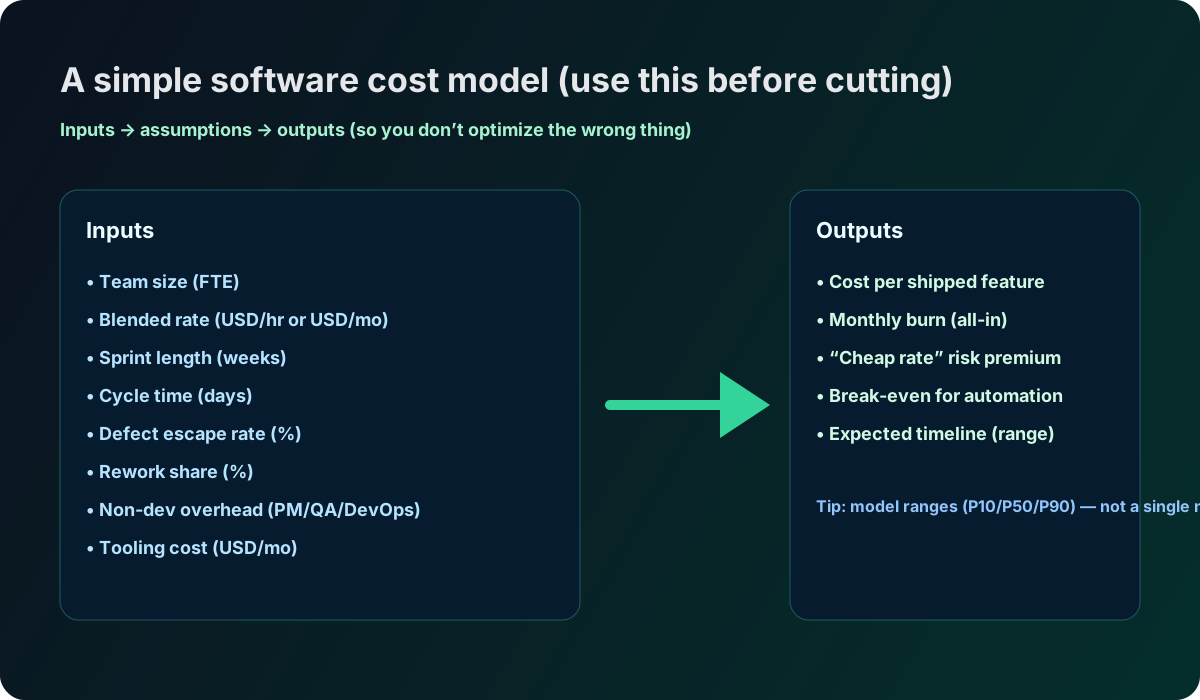
Here’s a spreadsheet concept you can implement in 15 minutes:
- Inputs: team size, blended rate, overhead, cycle time, defect/rework rates
- Outputs: monthly burn, cost per shipped feature, expected timeline range, automation break-even
What to put in the spreadsheet (minimal version)
Inputs (columns):
- Team size (FTE)
- Blended rate (USD/hr or USD/month)
- Non-dev overhead (PM/QA/DevOps as % or headcount)
- Cycle time (days from “in progress” → “production”)
- Rework share (% of sprint spent fixing, reworking, or clarifying)
Outputs (calculated):
- All-in monthly burn
- Estimated features shipped per month (use ranges)
- “Cost per shipped feature” (burn / shipped)
Now you can test scenarios:
- Cut rate by 20% but cycle time gets 30% worse → total cost increases.
- Add QA automation + CI → burn increases 8% but rework drops 25% → total cost decreases.
If you want a sanity-check for Vietnam hiring, start with a role that’s easiest to compare (e.g., a backend engineer) and look at market profiles like /vietnam/backend-developer.
Scope control: the fastest (and safest) way to reduce cost
Scope is the lever that reduces spend immediately without depending on hiring miracles.
1) Write outcomes, not feature lists
Replace “Build X screens” with “User can accomplish Y in under Z minutes.” When outcomes are clear, teams can propose cheaper implementations.
2) Slice MVP by risk, not by modules
A cost-effective MVP is not “the smallest version of everything.” It’s “the smallest version that proves the risky assumptions.”
A reliable slicing pattern:
- Risk-first: the riskiest part (data model? payments? latency?) gets built and validated early.
- Thin vertical: one complete end-to-end user journey.
- Kill list: things you explicitly won’t build this quarter.
3) Use “kill criteria” to stop bad work early
A brutal but healthy rule: if a feature doesn’t improve a north-star metric (or remove a major support cost), it’s a candidate to cut.
Team model choices: in-house vs agency vs dedicated team
If your aim is to reduce software development costs over months (not just weeks), the team model matters.
In-house (direct hires)
Usually best when:
- You’re building a long-lived product
- You need deep domain knowledge
- You want tight ownership and culture
Hidden costs: recruiting, management overhead, onboarding time.
Agency / project vendor
Best when:
- Scope is well-defined
- You need speed for a fixed deliverable
Risk: incentives can drift toward shipping “done enough” rather than building maintainable systems.
Dedicated team (Vietnam-first staff augmentation)
A dedicated team can be a strong middle ground when you want:
- Lower blended rates than many Western markets
- Full-time commitment and continuity
- The ability to scale up/down without permanent hires
If you’re hiring for a specific stack, start with a clean requirement and a target range, then source candidates or teams directly:
Vietnam rates: a quick reality check (and when Vietnam is a fit)
Vietnam is often a good fit when you need high-quality engineers at a lower cost than many US/EU markets—but it’s not magic. Your cost advantage depends on:
- How well you define scope and quality bars
- Your ability to run a tight delivery process
- Whether you can hire for the right stacks and seniority
A practical way to reduce risk is to run a trial sprint (1–2 weeks) with a real slice of product work and explicit acceptance criteria.
Process upgrades that reduce cost (without reducing quality)
Cost goes down when the feedback loop gets tighter and waste becomes visible.
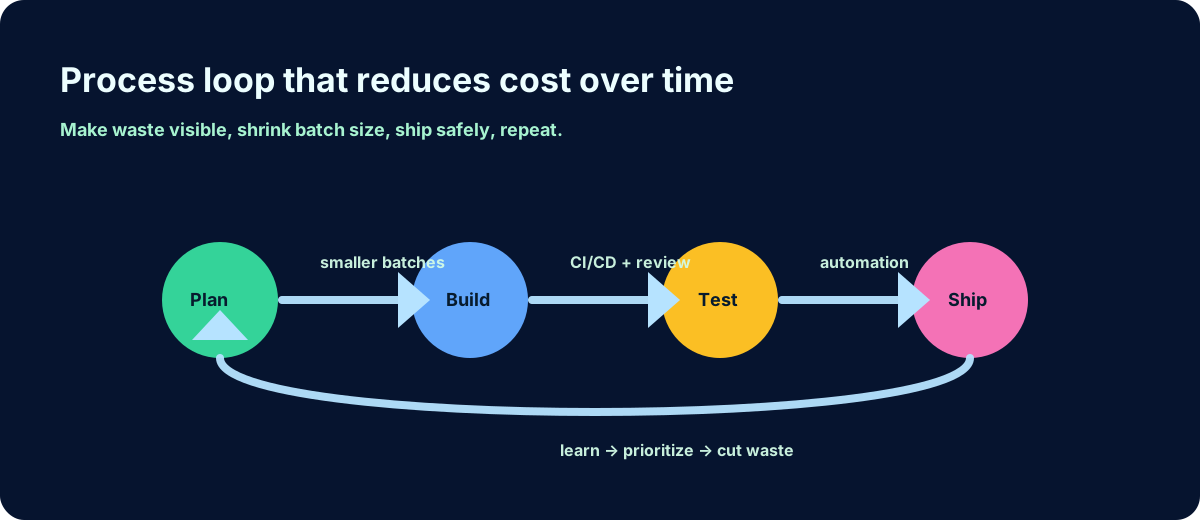
1) Use pull requests as a cost-control tool
A lightweight but consistent PR discipline reduces:
- Defects (less QA firefighting)
- Rework (better shared context)
- Bus factor risk (knowledge is documented in reviews)
Concrete PR rules that work well for remote teams:
- PRs < 300 lines when possible
- “Why” in the description (what problem is solved)
- Automated checks required to merge
- Review SLA (e.g., within 24 hours)
(For reference, see GitHub’s docs on pull requests: https://docs.github.com/en/pull-requests)
2) Measure DORA metrics (because you can’t optimize what you can’t see)
If you’re trying to reduce cost, you want to improve delivery efficiency and reliability at the same time.
DORA metrics (deployment frequency, lead time for changes, change failure rate, time to restore service) are widely used for this reason.
Background reading (non-competitor):
- DORA / Accelerate overview (Google Cloud): https://cloud.google.com/architecture/devops/devops-measurement
3) Make releases boring
Most hidden cost is “release drama”: late nights, hotfixes, rollback chaos.
A boring release pipeline usually has:
- CI that runs fast and consistently
- Feature flags for risky changes
- Staging environment parity
- Automated rollbacks where possible
CI/CD references:
- GitHub Actions docs: https://docs.github.com/en/actions
- Trunk-based development (Atlassian guide): https://www.atlassian.com/continuous-delivery/continuous-integration/trunk-based-development
Tooling that lowers cost (tracking, QA, automation)
Tools don’t reduce cost automatically. They reduce cost when they prevent repeat work.
1) Issue tracking that enforces clarity
Use templates that force:
- “Definition of done”
- Acceptance criteria
- Edge cases
Jira isn’t required. The principle is.
2) Test automation where it pays back
Focus automation on:
- Critical user journeys
- Payments/auth
- Regression-heavy areas
If you need a structured testing baseline:
- ISTQB glossary (concepts, not a competitor): https://glossary.istqb.org/
3) Security automation (avoid expensive incidents)
A single vulnerability incident can erase months of “cost savings.” Use baseline automation:
- Dependency scanning
- Secret scanning
- SAST where practical
References:
- OWASP Top 10: https://owasp.org/www-project-top-ten/
Common mistakes: “false savings” that backfire
This is where most teams lose money.
False saving #1: hiring cheap without ownership
If your vendor/team won’t give you:
- Repo access and code ownership
- Documentation and runbooks
- A clear handover path
…you don’t have a cost advantage. You have a future rewrite.
Vietnam-specific de-risking step: insist on a trial sprint with explicit deliverables, and keep your own GitHub org ownership from day one.
False saving #2: cutting QA entirely
Cutting QA can look like a quick win until you pay the cost as:
- Higher support load
- Slower releases (fear)
- More production incidents
A cheaper pattern is “shift-left” QA: automate the repetitive checks and reserve human QA for exploratory and high-risk flows.
False saving #3: “we’ll refactor later” forever
Some refactors can wait. Many can’t.
A good compromise: allocate a small, explicit budget for tech debt paydown (e.g., 10–20% of capacity), targeted at the parts that cause real rework.
Practical next steps: a 30-minute cost reduction audit
Use this checklist to find savings you can trust:
- List your top 10 in-progress epics/features.
- For each, write the outcome and the kill criteria.
- Estimate rework share over the last 2 sprints.
- Pick 1 process improvement (PR rules, CI reliability, release checklist).
- Pick 1 scope cut you can ship today.
- If considering Vietnam: run a 1–2 week trial sprint with repo ownership and a definition of done.
If you want to staff up quickly with Vietnam-first talent for a specific stack, start here:
And if you’re hiring by role:
FAQ
Does outsourcing to Vietnam always reduce software development costs?
Not always. Vietnam can reduce costs when you keep scope tight, hire for the right seniority, and run a delivery process that protects velocity (CI/CD, code review discipline, clear acceptance criteria). If you outsource to the cheapest bid without ownership, you often pay later.
What’s the fastest way to lower software development costs without slowing down?
Start with scope control (MVP slicing + kill lists). Then improve velocity by reducing rework: clearer requirements, smaller PRs, CI reliability, and automation where it pays back.
What should I demand from a Vietnam-based team to avoid false savings?
At minimum:
- Repo ownership under your org
- Transparent communication (daily async updates or standups)
- A written definition of done
- A trial sprint with measurable deliverables
- Documentation/runbooks for anything that’s operational
If you want to compare candidates or teams quickly, start with /developers and post roles at /jobs.